

The inspiration for the two turn combat system came from going to visit the Namdroling Golden Monastery in Karnataka, India. There’s a lot you can think about on a long winding drive through twisting roads up and down a mountain, so not ALL of it was dorking about how to make a healer main character not a total borefest to play, but at least some of it was. The problem with healers in RPGs is that they’re basically reactive; health goes down, healing spells get cast. Health not go down, then.. bonk with stick or defend, because your stick bonks are pretty pathetic.

I don’t claim to have a great understanding of Buddhism, but seeing the dedication the monks painted into the temple was almost overwhelming. These are obviously people dedicated to their faith and the mysteries buried in it; what they created was an intricate invitation to study and learn those mysteries, or at least much as you may be ready for. Their devotion comes not only in prayer, but in action: This was as much an act of faith as it was an act of love. Beauty was created, but beauty was created not for its own ends, but because in that is buried something to bring the curious onlooker along.

So why should a healer stand around and waffle between “bonk with stick” or “make green numbers appear over friends?” If a priest is trying to bring good into the world, shouldn’t they take action and not hide behind their pulpit, jabbering words? Or, they can jabber words AND take action, just as long as they’re living their faith.
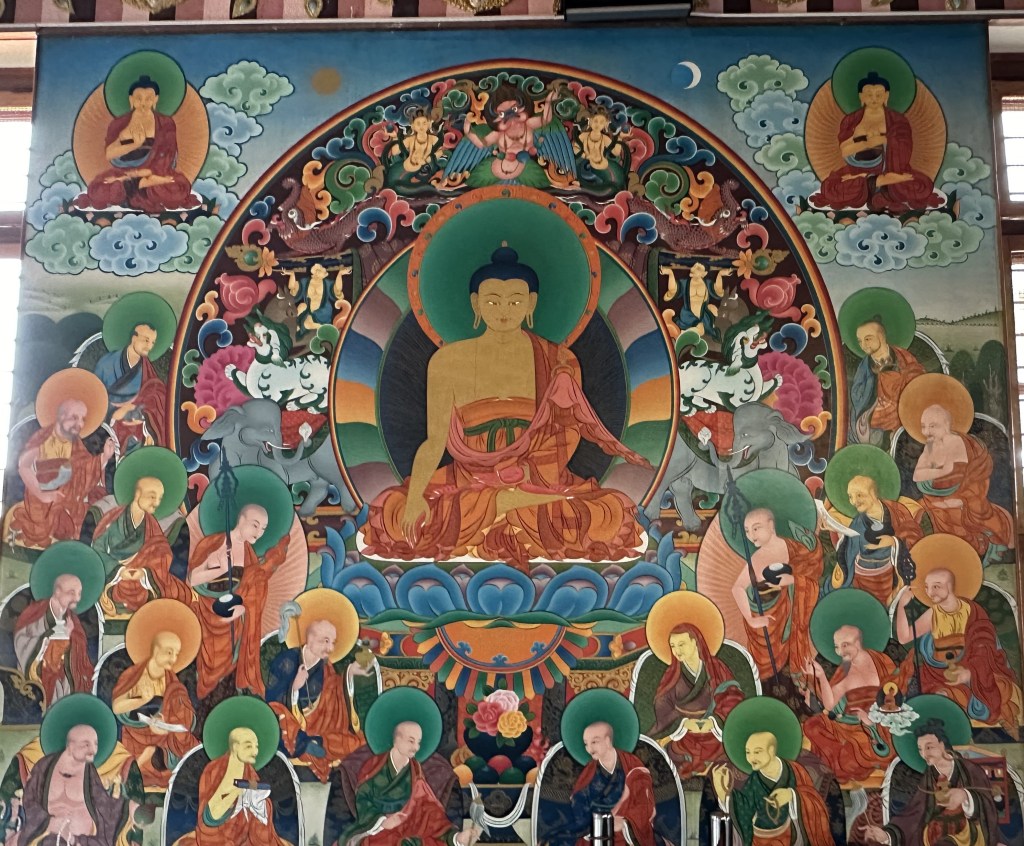
The other piece I wanted to share was the duality. I was really struck by the illustrations of Buddha as serene ally and bestial warrior. When embracing the pure and noble, the Buddha is a sage and guide, placid and welcoming. Not all of our nature is pure and noble, and there must be struggles against the base and wicked tendencies that try to take us from reaching our higher goal. So when you see peaceful friendly Buddha turn into a colorful Oni looking “wrathful deity”, it is time to check yourself for impure thoughts lest you get wrecked.

(And just to make wholly sure I am not goofing up the retelling of this, here’s a placard)

Not that I am writing Alastrina to be high on the road to enlightenment, per se, but she is not a meek bystander, standing in the back throwing heals on the more important party members. She fiercely protects her allies, and if that means she is needed to become fierce and destroy obstacles, she will of course do so when called.
Her attack moves don’t deal a ton of damage, but what they dish out is punishment – debuffs, mostly. The goal is that she intervenes in the fight and uses her staff to daze, blind, trip, whatever she can to stop the fight. Some of her prayers add on to the misery, extending the duration of debuffs done to foes so that they may pay penance. In fact, that’s exactly what I’ll call that prayer, thanks, me! The goal of her station is to lead others towards enlightenment; killing them doesn’t generally lead to much of that. Well, sorta; I mean, they get to the Pearly Gates equivalent in this world and some judge shakes their head at them sadly. But that’s not really salvation while it matters.
I’ll share more of Alastrina’s moveset in a later update; still working on James for now, as his moveset most requires the combat engine to be flexible, and since I’m nailing down that design, might as well plumb its limits early. Alastrina is probably the simplest to design, engine-wise, but still, not all “bonk vs heal” simple. Because that is not what I learned on my field trip!




 The Also-Rans
Leave a comment